
3rd July, 2026
Review by: Chris Spencer, Addiction Specialist
A Daily AI Companion for Recovery: Accountability That Works
- Outpatient Addiction Treatment Centre
I sat down recently to write the next article in this AI series. The title was already in my mind: Can AI Predict Relapse Before We Do?
At first, it seemed like a fascinating question. The more I thought about it, however, the more I realised I was asking the wrong question.
Artificial intelligence cannot predict relapse without information, any more than a therapist can.
Recovery doesn’t happen in isolation. It happens in our everyday lives, through the choices we make, the habits we build, and the actions we take.
That was the moment this article changed direction. Perhaps the real question isn’t whether AI can predict relapse. Perhaps the better question is this:
Could AI become a daily recovery companion that helps us stay accountable to the actions we already know support long-term sobriety?
The more I explored that idea, the more exciting it became. Not because AI has all the answers. But because it might help us remember the answers we already have.
Recovery Is a Programme of Action
One of the greatest lessons I have learned during more than thirty years working in addiction recovery is that people rarely think themselves into lasting change.
They act themselves into it. Recovery has never been simply a way of thinking. It has always been a programme of action. The principles have remained remarkably consistent for decades. Practise gratitude, attend meetings, speak honestly, ask for help, exercise, eat well, sleep properly, read recovery literature, help another person, stay connected.
These are not complicated ideas. The challenge is remembering to practise them every single day.
Imagine Having a Daily Recovery Companion
Now imagine creating your own AI companion. Not a therapist. Not a sponsor. Not a replacement for human relationships. Simply a daily guide that asks you the right questions.
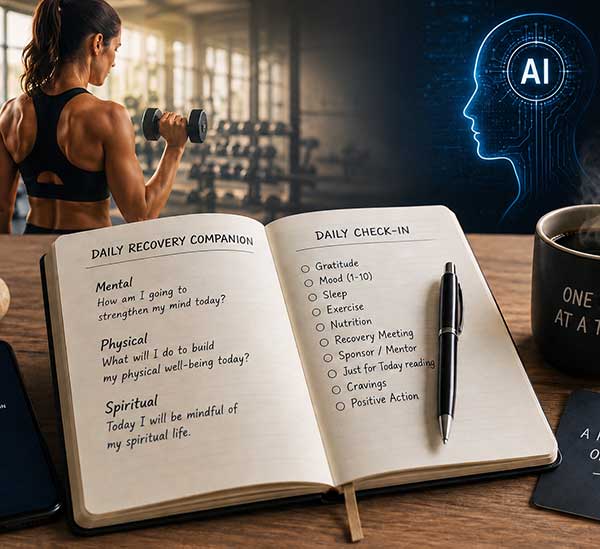
Before asking about gratitude, meetings or cravings, it could begin with three simple areas that have always been central to long-term recovery, our mental, physical and spiritual wellbeing. Every morning it might begin like this:
Mental
How am I going to strengthen my mind today?
Physical
What will I do to build my physical well-being today?
Spiritual
Today I will be mindful of my spiritual life.
It could then continue with a daily recovery check-in.
What are five things you’re grateful for today?
How would you rate your mood from one to ten?
How did you sleep?
Have you exercised?
Have you eaten well?
Have you attended a recovery meeting?
Have you spoken with your sponsor or mentor?
Have you completed your “Just for Today” reading?
Have you experienced any cravings?
What positive action will you take today?
None of these questions are revolutionary. Yet together they reinforce something extremely powerful. Daily accountability.
Make It Personal
The beauty of AI is that it doesn’t have to follow someone else’s programme.
It can follow yours. Perhaps your goals include:
Going to the gym four times each week.
Reducing sugar intake.
Walking 8,000 steps every day.
Spending quality time with your family.
Reading for twenty minutes each evening.
Meditating before bed.
Drinking enough water.
Being in bed by 10:30 pm.
Your AI companion simply asks about the goals that matter to you. Over time it begins to recognise your healthy routine. Not because it is replacing your judgement, but because it is helping you remain conscious of the commitments you have already made to yourself.
Holding Up a Mirror
People often think relapse begins with the first drink or drug. It doesn’t.
Relapse usually begins much earlier.
We stop doing the things that were keeping us well. Meetings become less frequent. Gratitude disappears. Exercise becomes tomorrow’s job. We withdraw from other people. We stop answering the phone.
Our thinking slowly changes because our behaviour has changed first. An AI companion cannot diagnose relapse. But it can hold up a mirror.
It might gently say:
“Over the past two weeks your gratitude entries have become much shorter. You’ve missed several gym sessions and haven’t mentioned attending a recovery meeting. Would it help to speak with your sponsor or therapist?”
Notice the difference. It isn’t predicting the future. It is simply reflecting the patterns you have chosen to record. Sometimes that gentle reminder may be enough to change direction.
TURN INSIGHT INTO ACTION, ONE DAY AT A TIME
Speak with us. All conversations are confidential, with no obligation.
A Personal Recovery Diary
For many years people have kept handwritten recovery diaries. Artificial intelligence offers a modern version of the same idea. Instead of writing into a notebook that sits on a shelf, you can create a conversation that develops with you over time.
The more honest you are, the more useful it becomes. The AI doesn’t judge. It doesn’t criticise. It simply encourages you to remain accountable to your own goals. Like every useful diary, its value depends entirely upon your honesty.
The more honest you are, the more useful it becomes. The AI doesn’t judge. It doesn’t criticise. It simply encourages you to remain accountable to your own goals. Like every useful diary, its value depends entirely upon your honesty.
What AI Cannot Do
It is equally important to understand its limitations. Artificial intelligence cannot replace a therapist.
It cannot replace a sponsor.
It cannot replace family.
It cannot replace friendship.
It cannot hug someone who is frightened.
It cannot sit quietly with someone who is grieving.
It cannot make difficult decisions for us.
Recovery will always be built upon human relationships, honesty, courage and action. AI should never replace those things. It should strengthen them. The greatest danger would be believing that technology can replace connection. It cannot. The strongest recovery has always been built upon people helping people.
One Day at a Time
Perhaps the greatest strength of artificial intelligence isn’t that it knows more than we do. Perhaps its greatest strength is that it reminds us to do what we already know works. Recovery has always been lived one day at a time.
One meeting.
One conversation.
One act of gratitude.
One healthy meal.
One walk.
One honest decision.
Artificial intelligence cannot take those actions for us. But it may remind us to take them. And sometimes that gentle reminder, repeated day after day, may help keep us on the path we have chosen.
Recovery has never been a programme of thinking. It has always been a programme of action. AI will never walk the path of recovery for us. But it may remind us, every single day, to keep walking it. Perhaps that is not predicting relapse. Perhaps it is helping us prevent it, one day at a time.
If you think that you or someone you love might have a problem with drug or alcohol addiction, compulsive behaviour or emotional disorders, reach out and speak to our specialist addiction rehab treatment team on our confidential helpline +34 691 881 422. Immediate admission available.
Popular Blogs
-

Step Eleven: Finding Clarity, Balance, and Direction
Step Eleven is often misunderstood. Some people hear the words “prayer” and “meditation” and assume that the step is only for those who already feel certain about spirituality or religion. Others worry that it is too abstract to be useful.
-

The Wider Benefits of the Twelve Steps | Personal Recovery Journey
For many years, I believed that if I could stop drinking, everything in my life would be alright. Of course, stopping was essential. Alcohol had caused enormous problems in my life and had affected the people around me.